
Cognitive Pacing
Backgammon, Netflix, and Romance Novels

When I got ME/CFS, I was working remotely as a public health researcher. I was on my computer from home all day, with occasional trips for work. My ability to work was entirely based on my cognitive, executive, and social functioning, with little physical capacity needed beyond typing and staying awake. I’d never before thought about fatigue in any realm other than physical. I was taken by surprise when I realized that my new physical exhaustion came with cognitive challenges.
Two early experiences shaped my understanding of ME/CFS's cognitive toll. First, I discovered that I couldn’t read complex writing. I picked up The New Jim Crow by Michelle Alexander, a book I was excited to read. I read the first page 3 times and couldn’t hold on to what was said at the top of the paragraph long enough to understand what came at the end of the paragraph. After years of reading and writing scientific articles, I was used to digesting books written for the general public, even if the topic was outside my area of expertise. The cognitive fog that kept me from being able to take in her clear and engaging writing felt like trying to read medieval English: the words got through, but the meaning did not.
Then came a second lesson: even when I could think clearly, cognitive exertion had physical consequences. About a year into my illness, I did a “quick” literature review for a friend. One day, I spent 4 hours on the sofa doing the review. The next day, I was completely flattened: I felt like I’d been hit by a Mack truck. I learned that there are multiple aspects of cognitive impairment from ME/CFS. Sometimes I simply couldn’t think; I couldn’t take in or produce information. Other times, I could function intellectually, but the effort triggered a crash that lasted for hours or days.
Learning to pace myself cognitively meant rethinking mental exertion. Before, I was functioning at a high intellectual level in my work seemingly effortlessly. Now I have to be discerning. During my first 3-4 years with ME/CFS, I played lots of online card games and became proficient at online farming.
For those four years, the only books I read were romance novels. While I have always been a fan of a good romance novel, after becoming ill, they became the only thing I could read. The small cast of characters, clear and predictable storyline, and assured happy ending were doable for me. They provided enough interest to keep me engaged, but were simple enough that I could follow along. In a time of great uncertainty (and let’s face it–not a lot of sex!), the assured happy ending mattered.
In the past year, my sister and my second cousin each became sick with Long COVID. Watching their journeys has reinforced how much we share these cognitive impacts. My sister finds that light concentration, like playing an online card game, sometimes helps reduce her post-exertional symptoms, even better than full rest. My cousin mentioned that she’s played more Backgammon in the past year of Long COVID than the rest of her life combined. She, like I, felt like it was a sign of wasted time.
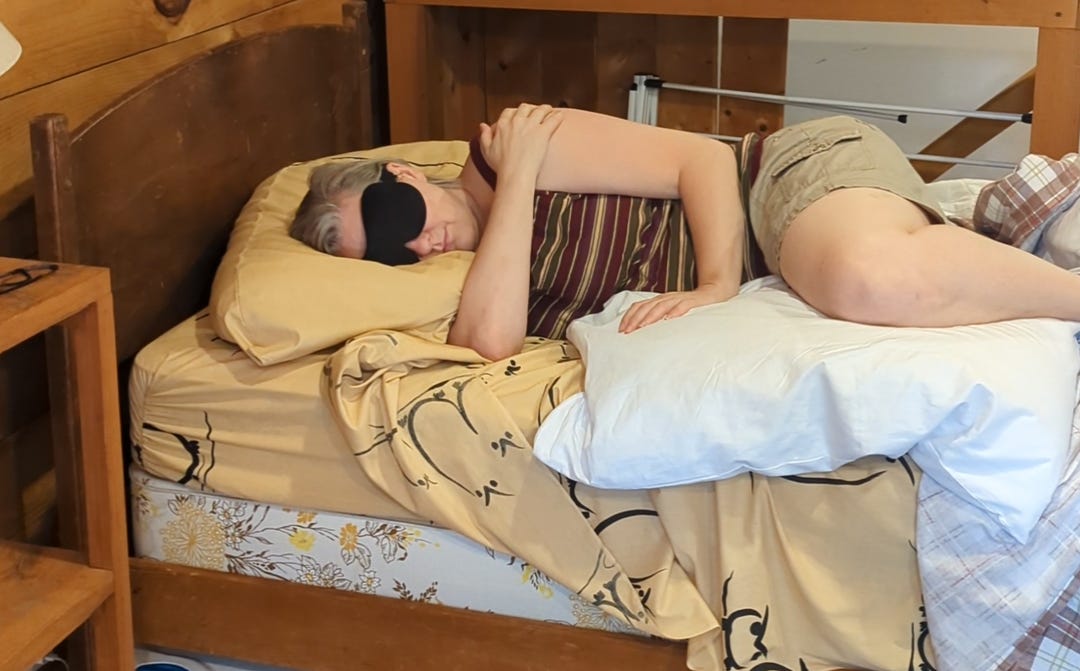
Increasingly, I’m thinking about these activities as part of a spectrum of activities that constitute the scaffolding for cognitive pacing. On my worst days, I'm in bed, not looking at anything. I tolerate zero sensory stimulation. On my best days, I can read, analyze, write, and produce at almost my pre-illness capacity as long as I manage the number of hours I do so. Most days are somewhere in between. I have found the following hierarchy of activities allows me to calibrate to whatever my functionality is on a given day or hour. Here they are from lowest cognitive engagement to highest (more or less):
Play Online Cards: This is the lowest level. No text. No sound (which I have turned off in settings). Minimal movement. It goes at my pace. I usually start with spades, then play cribbage, and then do a Sudoku. On my worst days, I might be here most of the day. On many days, I use them to gather myself early in the day, which is always the hardest part of the day for me.
Listen to an Audiobook: I can lie down, close my eyes, adjust the speed, and pick up where I left off if I doze. I listened to Robin Wall Kimmerer’s short book called Service Berry last week. 1.5 hours of delight
Listen to a Podcast: Depending on the topics, this can be more or less taxing than an audiobook. I tend to listen to intellectually engaged shows. My favorite recent listen was Scene on Radio’s 7th season, “Capitalism”. I regularly listen to We Can Do Hard Things.
Flip through a Magazine: I move at my own pace, choosing whether to read or just look at pictures. A low-stakes way to engage with the world.
Meditate: On my lowest days, I can’t muster the internal focus to quiet my mind. The external distraction of cards or an audiobook is required to get out of myself. In order to meditate, I find I need to feel good enough to be willing to go into myself. There’s a level of discipline that evades me on low days. The irony, of course, is that when I do meditate, I always feel better afterwards. I’m still working on how to get myself to do it on my low days.
Write or Draw in a Journal: Like meditation, this can be very calming, but also takes internal initiative. When I have that, journaling is soothing and clarifying. I’m not always clear about the relationship between my cognitive capacity and my internal motivation. It’s not linear.
Watch a Movie or other Video: A movie, even a nature documentary (which is what I turn to on my lower days), has both visual and auditory stimulation, so it automatically requires a higher level of cognitive engagement. Shorter videos can be easier, but deciding what to watch is hard when my tolerance for making choices is very low. This is where Sage’s system of identifying movies and videos ahead of time that fit with differing levels of energy would be good if I had the discipline to do it… My favorite nature documentary is Our Great National Parks, narrated by Barack Obama.
Read a Romance Novel: For me, this is the easiest kind of book to read, which doesn’t mean I do not discern good ones from bad ones! I have identified the authors who write well and who include interesting aspects that I most enjoy (like NOT all rich, White, able-bodied, young, cis, straight people!). We will be highlighting some of my favorites in our Book club in the coming months.
Read Nonfiction or Other Complex Book: Recently, I’ve been reading more books on Spirituality and Rest. I’m a huge fan of Tricia Hersey’s Rest is Resistance. I’m looking forward to diving into books on disability theory with Sage.
Do Work that Requires Analysis, Synthesis, or Creative Output: This year, I’ve been able to include more days of paid work in my field. Currently, I have to keep it to no more than 2 hours a day and no more than 8 hours a week. But there have been many years over the last 12 when even that was not available to me, so I am grateful!
So well said and broken down! It’s so interesting how cognitive drain is different for each of us. At my worst, audio listening of any kind would send me into full shutdown mode (this was especially when the sound was being emitting from my left side). I could watch fifteen minutes of TV before I could start listening to audio, which I always found so strange/backwards. I’m happy to hear that you’ve been able to add more things. Thanks for sharing your experience!
Thank you! Thats fascinating that sound from one side was worse than the other. This stuff is so bewildering sometimes!
I hope it didn’t sound like I was suggesting that my hierarchy should be anybody else’s. I just recently came to the realization that we can pace ourselves cognitively like we do physically.
I wish you moments or even “gasp” whole days of cognitive ease!